
Why we made Icelandic AI
We sat down with Sandra last week for a proper chat on everything from how she learnt Icelandic, to the state of options available, and top tips to learn the language more effectively…we asked her to be more blunt than James Blunt with the cheapest IKEA knife. Enjoy!
What’s the state of Icelandic learning right now?
Honestly, it’s a bit of a mess for learners. As a teacher, your whole goal is to deepen your students’ understanding and guide them through clear progression from level to level.
The schools I worked at didn’t really base their courses or structure on any methodology. In fact the curriculum tended to be whatever the senior educator felt worked, and most of the teachers in those classrooms weren’t qualified to teach a language. Add to that no progress monitoring, and funding models that reward hours of attendance rather than real learner progression, and you can see why so many learners end up frustrated, and regularly moving between the schools looking for a better option (…and each school curriculum is completely different which learners are often unaware of).
In short, I wanted to fix these problems as much as possible by creating Icelandic AI.
Is there anything misleading out there?
Yes.
And it’s worth flagging so learners can spot it.
Some schools simply mis-sell. For instance, one in the South of Iceland advertises C-level courses after just five levels, which under any serious framework is completely absurd. C-levels are the top tier of mastery, and getting there properly is a much longer road than that.
There’s also a popular app (widely endorsed by local companies) that tells learners they don’t need grammar. Almost every credible language educator will tell you that’s not how it works, especially with Icelandic. Skip the grammar and all you do is memorise.
And there’s a common assumption that if you speak Icelandic natively, you can teach it. Native fluency is a wonderful starting point, but teaching is a completely different skillset. “It just is” is the response we all want to avoid giving, because learners deserve the actual why.
So why did you make Icelandic AI?
Because learners deserved a proper system. Something structured, systematic, and available whenever life allowed for it. Somewhere you can track your own progress, revisit anything as often as you like, and actually start to understand Icelandic piece by piece aligned with a consistent framework.
Icelandic AI is designed to take you from the very basics through to the upper levels (and further, as we keep building) and it explains how Icelandic works, not just what to memorise.
The other thing I always tell learners: pair it with immersion. Not the intimidating kind. The everyday kind. Tell your colleagues, your family, your friends that you want to speak Icelandic with them. You won’t pick it up as smoothly as a baby, but the mix of structured study plus real-world use is genuinely powerful.
When I was learning myself, I worked at a nursing home in Reykjavík and spoke to my co-workers and the residents in whatever Icelandic I could piece together. I made a lot of mistakes. Some of them were properly funny. I kept going, and that’s the part that matters most.
What’s the actual value in Icelandic AI?
The biggest one, in my view: you can revisit everything, as often as you like. That’s genuinely rare, and it’s a game-changer for Icelandic specifically.
Icelandic grammar rewards repetition. Your brain needs to see the same patterns from different angles before they click. In a physical school, revisiting means paying again for another course, often taught differently (possibly not a great teaching experience), and you lose consistency. With Icelandic AI, you can go back to any lesson or practice, any time, and the teaching is the same.
Are there any hacks to learning Icelandic faster?
There’s always a hack.
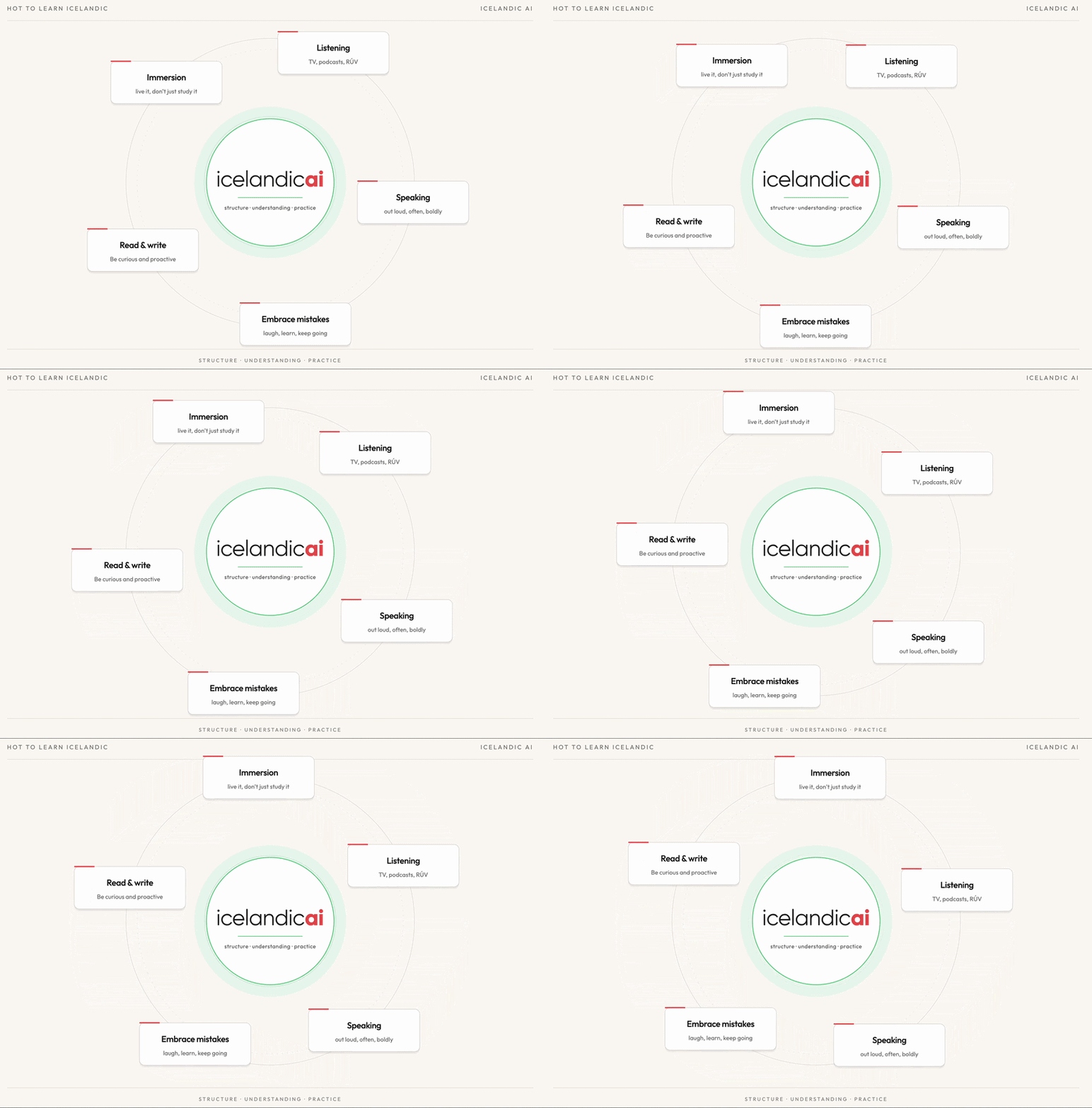
Use Icelandic AI for the structure, the understanding, and the practice. Then surround yourself with the language however you can. Colleagues, family, friends, TV, podcasts, RÚV in the background while you cook. It sounds like standard advice, but it works because it reinforces the structure you’ve already built. You start hearing the pace, the tempo, and all those delightful seemingly-joined-together shortcuts locals use in every language. Er það ekki!?
When I was first learning, I did the classic of memorising set conversation sequences (like ordering a coffee). But the real breakthrough was learning the sentences that buy you time. Ways to ask someone to slow down, or rephrase, or repeat themselves. It kept the conversation in Icelandic, which as you know is half the game.
How could Icelandic learning be improved?
Four things I’d love to see.
One. More everyday exposure and usage. Be bold, make mistakes, turn them into funny stories (that’s how we come up with ads). Just own the silliness and enjoy it.
Two. Erasing the myth that Icelandic is impossibly hard. It just needs to be taught properly one logical step at a time. For most European speakers (sorry, English) the structure is actually really logical once someone explains it to you.
Three. Locals being a bit more patient when they hear Icelandic spoken with an accent, and resisting the urge to switch to English out of kindness. That switch is the single biggest blocker to real progress for non-natives, and a small shift there would make an enormous difference.
Four. Measuring success in Icelandic education by learner outcomes, not by hours in a seat. When we measure actual learner progress, everything else follows for the better.
What about AI? …dare I ask is it any good at Icelandic?
For serious learning, absolutely not (we can often tell when some of our learners email us with machine translations!). We actually thought about making a few funny videos on this, because the confidence with which LLMs double down on incorrect Icelandic is quite entertaining. But it’s not learning material. It’s rife with errors and wording that doesn’t reflect how people actually speak.
You’ll also spot the odd ad from people who don’t speak Icelandic promoting AI-based solutions, which adds a lot of noise to the already confusing Icelandic education market. Language teaching belongs with the professionals.
And why is it called Icelandic AI? Do you regret the name?
Ha, good question. It’s called Icelandic AI because we use avatar versions of me and others inside the video lessons. That’s the only place AI lives in the platform. Everything else, the curriculum, the writing, the scripting, the editing (and the jokes!), the QC, is made by me and our team.
We did it that way so we can translate the teaching into multiple languages while keeping the standard consistent. And the translations themselves are done by heavily caffeinated humans who can contextualise things properly, with dedicated QC on top.
Do we occasionally regret the “AI” in the name? A little, yes. Some people see it and assume the whole thing is a machine-generated scam, which is a shame because the learners who actually use it tend to love it (the reviews genuinely make our day).
For us, the AI in our brand name stands for actual intelligence. Delivered by real people, built for real learners, done properly.