
Meet the learner Series: Stella
Welcome to the very first issue of Just here to widen the gene pool. In this series we will be reaching out and interviewing members of the Icelandic AI community to ask them about their personal stories, life in Iceland, learning the language, some of the kjaftæði (BS) they may have encountered, and some of the mistakes and triumphs along the way. Brutal honesty only please.
Today’s learner is Stella, who has been in Iceland for eight years and was brave enough to be the first one to answer our questions…and very clearly state her thoughts on taxes (no spoilers – read on).
1. Tell us a little about yourself and the story of what brought you to Iceland.
Stella: I’m Stella, and Iceland has been my home for the last eight years. Honestly? A bunch of coincidences. I wanted to move somewhere, and the only condition I had was that it couldn’t be a German-speaking country.
2. What has surprised you most about living in Iceland?
Stella: How slow everything is.
Editor’s note: …we highly doubt anyone in our community could challenge this statement while holding a straight face.
3. What made you decide to learn Icelandic, and what has the journey been like so far?
Stella: I plan to stay in Iceland for some time, so it felt like a natural decision. The journey itself has had its ups and downs, depending on how much time and effort I’ve had to give it.
4. What have you found most difficult about Icelandic, and have you ever made a particularly funny mistake?
Stella: I feel like people often speak so quickly that they don’t pronounce all the sounds in the words. And oh yes. Instead of saying skattur, I ended up saying something that sounded a lot more like skítur.
For anyone who doesn’t know: skattur means tax. Skítur more describes skattur for some of us. We’ll leave it there.
5. Before Icelandic AI, how had you tried to learn the language, and what did you feel was missing?
Stella: Through a group class at a language school. The main thing that was missing was an individual approach, since not all of the students were at the same level. It seemed like the only real option to learn at the time, which is where I think most of us hit a wall of realistic options to learn alongside work.
6. What made you try Icelandic AI, and what was your first impression?
Stella: Knowing what a great teacher Sandra is. Honestly, I’m enjoying it so much more than I expected.
7. Which parts have been most useful or enjoyable for you?
Stella: The ability to go through some lessons more than once. Some parts take a little longer to sink in, so it’s great to be able to come back to them a few days later.
8. Can you share a moment when something you learned helped you in real life?
Stella: It’s actually a lot of everyday moments. You finally start to feel like you’re not spending so much energy just navigating everyday life in a foreign country.
9. If you woke up tomorrow completely fluent, what’s the first conversation you’d want to have?
Stella: I have no clue. Honestly.
The most honest answer we’ve ever had to that question, and we haven’t even asked it before.
10. What would you say to anyone on the fence with Icelandic AI?
Stella: Honestly, you won’t regret it. The depth of content, amount of practice, feedback, and features makes it an obvious no brainer. You can tell a lot of work went into it and Sandra still managed to keep her personality just as entertaining throughout. Plus with union remibursements it’s almost nothing. Get off the fence.
11. Stella, what is your question for the next learner?
“Is there an Icelandic word you are still afraid to pronounce?”
Stella, thanks for the stellar honesty. And to the rest of you, thanks for reading. See you in Issue N° 02.
Why we made Icelandic AI
We sat down with Sandra last week for a proper chat on everything from how she learnt Icelandic, to the state of options available, and top tips to learn the language more effectively…we asked her to be more blunt than James Blunt with the cheapest IKEA knife. Enjoy!
What’s the state of Icelandic learning right now?
Honestly, it’s a bit of a mess for learners. As a teacher, your whole goal is to deepen your students’ understanding and guide them through clear progression from level to level.
The schools I worked at didn’t really base their courses or structure on any methodology. In fact the curriculum tended to be whatever the senior educator felt worked, and most of the teachers in those classrooms weren’t qualified to teach a language. Add to that no progress monitoring, and funding models that reward hours of attendance rather than real learner progression, and you can see why so many learners end up frustrated, and regularly moving between the schools looking for a better option (…and each school curriculum is completely different which learners are often unaware of).
In short, I wanted to fix these problems as much as possible by creating Icelandic AI.
Is there anything misleading out there?
Yes.
And it’s worth flagging so learners can spot it.
Some schools simply mis-sell. For instance, one in the South of Iceland advertises C-level courses after just five levels, which under any serious framework is completely absurd. C-levels are the top tier of mastery, and getting there properly is a much longer road than that.
There’s also a popular app (widely endorsed by local companies) that tells learners they don’t need grammar. Almost every credible language educator will tell you that’s not how it works, especially with Icelandic. Skip the grammar and all you do is memorise.
And there’s a common assumption that if you speak Icelandic natively, you can teach it. Native fluency is a wonderful starting point, but teaching is a completely different skillset. “It just is” is the response we all want to avoid giving, because learners deserve the actual why.
So why did you make Icelandic AI?
Because learners deserved a proper system. Something structured, systematic, and available whenever life allowed for it. Somewhere you can track your own progress, revisit anything as often as you like, and actually start to understand Icelandic piece by piece aligned with a consistent framework.
Icelandic AI is designed to take you from the very basics through to the upper levels (and further, as we keep building) and it explains how Icelandic works, not just what to memorise.
The other thing I always tell learners: pair it with immersion. Not the intimidating kind. The everyday kind. Tell your colleagues, your family, your friends that you want to speak Icelandic with them. You won’t pick it up as smoothly as a baby, but the mix of structured study plus real-world use is genuinely powerful.
When I was learning myself, I worked at a nursing home in Reykjavík and spoke to my co-workers and the residents in whatever Icelandic I could piece together. I made a lot of mistakes. Some of them were properly funny. I kept going, and that’s the part that matters most.
What’s the actual value in Icelandic AI?
The biggest one, in my view: you can revisit everything, as often as you like. That’s genuinely rare, and it’s a game-changer for Icelandic specifically.
Icelandic grammar rewards repetition. Your brain needs to see the same patterns from different angles before they click. In a physical school, revisiting means paying again for another course, often taught differently (possibly not a great teaching experience), and you lose consistency. With Icelandic AI, you can go back to any lesson or practice, any time, and the teaching is the same.
Are there any hacks to learning Icelandic faster?
There’s always a hack.
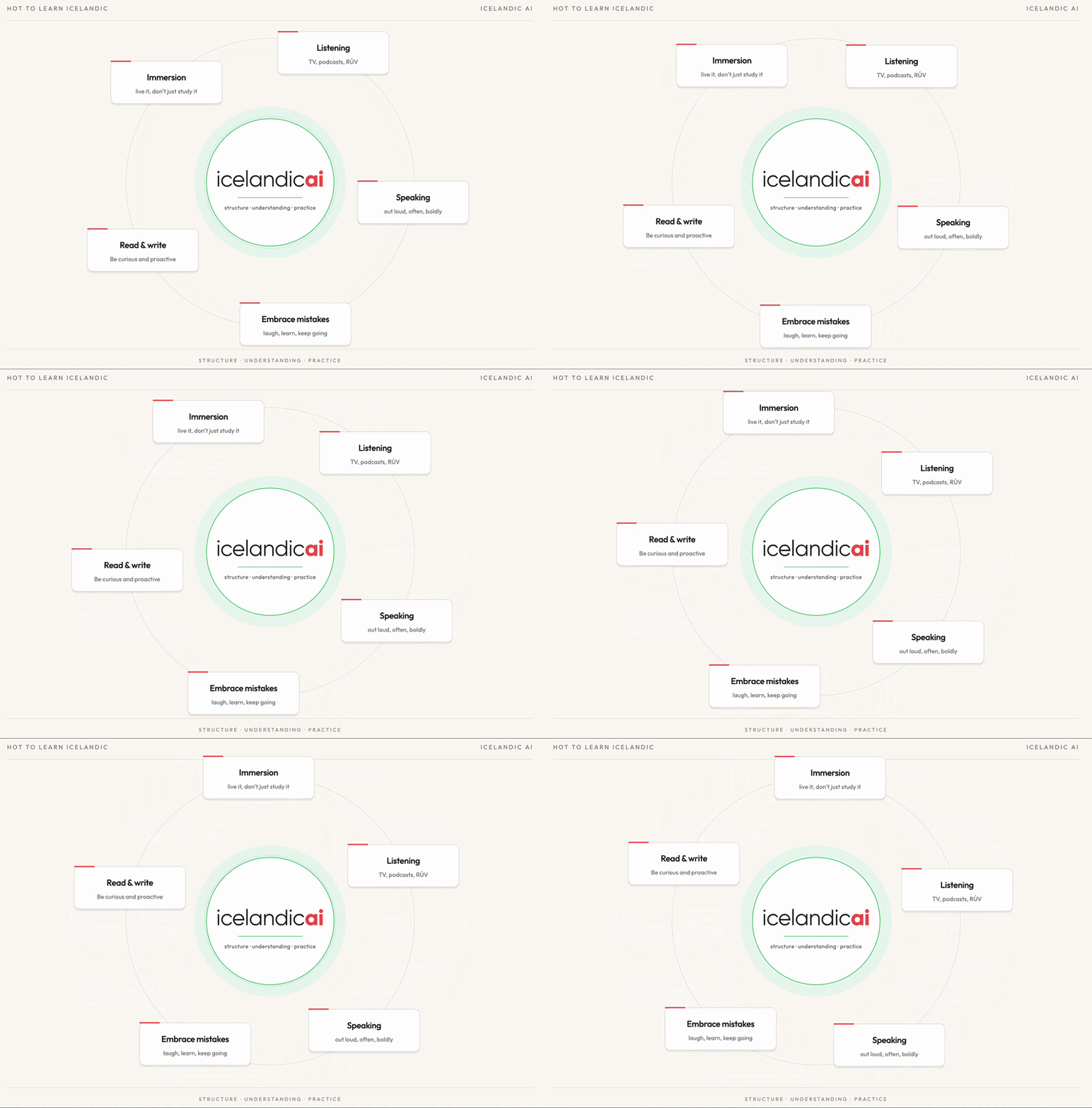
Use Icelandic AI for the structure, the understanding, and the practice. Then surround yourself with the language however you can. Colleagues, family, friends, TV, podcasts, RÚV in the background while you cook. It sounds like standard advice, but it works because it reinforces the structure you’ve already built. You start hearing the pace, the tempo, and all those delightful seemingly-joined-together shortcuts locals use in every language. Er það ekki!?
When I was first learning, I did the classic of memorising set conversation sequences (like ordering a coffee). But the real breakthrough was learning the sentences that buy you time. Ways to ask someone to slow down, or rephrase, or repeat themselves. It kept the conversation in Icelandic, which as you know is half the game.
How could Icelandic learning be improved?
Four things I’d love to see.
One. More everyday exposure and usage. Be bold, make mistakes, turn them into funny stories (that’s how we come up with ads). Just own the silliness and enjoy it.
Two. Erasing the myth that Icelandic is impossibly hard. It just needs to be taught properly one logical step at a time. For most European speakers (sorry, English) the structure is actually really logical once someone explains it to you.
Three. Locals being a bit more patient when they hear Icelandic spoken with an accent, and resisting the urge to switch to English out of kindness. That switch is the single biggest blocker to real progress for non-natives, and a small shift there would make an enormous difference.
Four. Measuring success in Icelandic education by learner outcomes, not by hours in a seat. When we measure actual learner progress, everything else follows for the better.
What about AI? …dare I ask is it any good at Icelandic?
For serious learning, absolutely not (we can often tell when some of our learners email us with machine translations!). We actually thought about making a few funny videos on this, because the confidence with which LLMs double down on incorrect Icelandic is quite entertaining. But it’s not learning material. It’s rife with errors and wording that doesn’t reflect how people actually speak.
You’ll also spot the odd ad from people who don’t speak Icelandic promoting AI-based solutions, which adds a lot of noise to the already confusing Icelandic education market. Language teaching belongs with the professionals.
And why is it called Icelandic AI? Do you regret the name?
Ha, good question. It’s called Icelandic AI because we use avatar versions of me and others inside the video lessons. That’s the only place AI lives in the platform. Everything else, the curriculum, the writing, the scripting, the editing (and the jokes!), the QC, is made by me and our team.
We did it that way so we can translate the teaching into multiple languages while keeping the standard consistent. And the translations themselves are done by heavily caffeinated humans who can contextualise things properly, with dedicated QC on top.
Do we occasionally regret the “AI” in the name? A little, yes. Some people see it and assume the whole thing is a machine-generated scam, which is a shame because the learners who actually use it tend to love it (the reviews genuinely make our day).
For us, the AI in our brand name stands for actual intelligence. Delivered by real people, built for real learners, done properly.
5 Icelandic Learning Myths
There’s a lot of advice out there about how to learn Icelandic, and a fair chunk of it is either wrong, or so incomplete that following it will genuinely waste your time and money.
Five myths I hear all the time from learners at every stage, and often shouted about in social media forums. Some I believed myself. Some I still see costing people way too much money. All are worth deleting from your head before you go any further.
Myth 01: You need a native speaker as your teacher
You don’t. In fact, in many cases, the complete opposite is better.
Native speakers grew up absorbing Icelandic. They didn’t have to learn it the same way you learn a language as an adult. Which means when you ask them why a certain case ending changes, or why a verb behaves the way it does, they often can’t answer. It just is. That’s fine at a dinner party, but it’s a problem in a classroom.
The teachers who tend to move learners fastest are the ones who learned Icelandic themselves. They know how you learn the Icelandic language properly, covering all the “why’s” along the way. It is a completely different skillset.
Myth 02: Language school instructors are qualified teachers
Sadly, no. In a lot of cases, teaching Icelandic is a side hustle rather than a profession. There’s no formal qualification required in most settings, which is why the experience of learners varies so wildly from class to class, even within the same school.
That’s not the teachers’ fault. It’s a system that doesn’t require the training and doesn’t measure the outcomes. It’s also one of the main reasons we built Icelandic AI. Learners deserve consistent, properly designed teaching every single time they open a lesson.
Myth 03: Six levels always get you to B1.2
This one hurts to write, because it’s not the learner’s fault. But no. If you did six levels at a language school and were told you’re now B1.2, chances are you’re not.
We see it constantly on our aptitude test. Learners come in expecting to place at a high intermediate level after years of schooling, and often place several levels below where they’d been told they were. It’s not because they’re bad at Icelandic. It’s because they were graded on hours in the classroom, not on what they can actually do.
Icelandic AI is different by design. You have to pass the tests to complete a course. If you can’t do it yet, you go back and practise until you can. It’s for serious learners. That’s the whole point.
Myth 04: Language schools will get you there eventually
Maybe. But at what cost, and after how much repetition?
Because language schools don’t have real pass marks, learners routinely repeat levels to “retain” the material. In a forum this week, I saw someone genuinely suggest taking Level
1 three times to make it stick. Let’s do the maths on that.
The maths
Language school. Level 1, taken three times to retain it.
~180,000 ISK
Icelandic AI. Level 1, repeat as many times as you like.
49,900 ISK
Take Level 1 five times if you want. Twenty. The pricing is the same. The teaching is the same each time. And you have at least 12 months of access.
And that’s just Level 1. Language schools compound this problem at every stage, because they are funded by how many students attend, with no pass mark required. Icelandic AI doesn’t. Once you buy a course, you go at your pace and your level of repetition.
Myth 05: You should work at Bónus or a nursing home to learn faster
I’ll take this one personally, because I did exactly that. I worked at a nursing home in Reykjavík when I was learning, and yes, it helped. But I don’t recommend it as a strategy.
You should not sacrifice your career for a language-learning shortcut that mostly isn’t one. The people who progress fastest aren’t the ones who changed jobs. They’re the ones who studied properly and then used their Icelandic in whatever environment they were already in. The office coffee break. The neighbour. The local shop. The kids’ teacher.
Learning happens where you already are, as long as you’re studying properly on the side to develop strong foundations and proper understanding.
Where does this leave you?
Learning Icelandic isn’t complicated. It just needs an honest system that doesn’t waste your time or your money, and a bit of consistency from you. That’s the whole thing.
If you’re still on the fence, take a look at Level 1 or get some extra value with our Level 1&2 bundle. If it’s not for you, no hard feelings. If it is, welcome in.